REWRITE: Could I live without digital communication technologies?

(This rewrite is done based on feedback provided. Due to technical difficulties, said feedback could not be posted as a comment. The feedback is instead placed at the bottom of this post in full, along with the original post)

In theory, it is completely possible to live without digital communication technologies (DCT), but it would have some rather serious consequences.

~85% of Australians own and regularly use their mobile phones, the most widely used form of DCT (Statistica, 2019). To start with the positives of giving up DCT, Volkmer, S., & Lermer, E. (2019) found a strong correlation between phone use and lower well being. Therefore, doing away with the phone should increase well being. That’s a clear benefit. However, the study also suggests that owning a phone and using it in moderation has much less of a negative effect on life satisfaction.
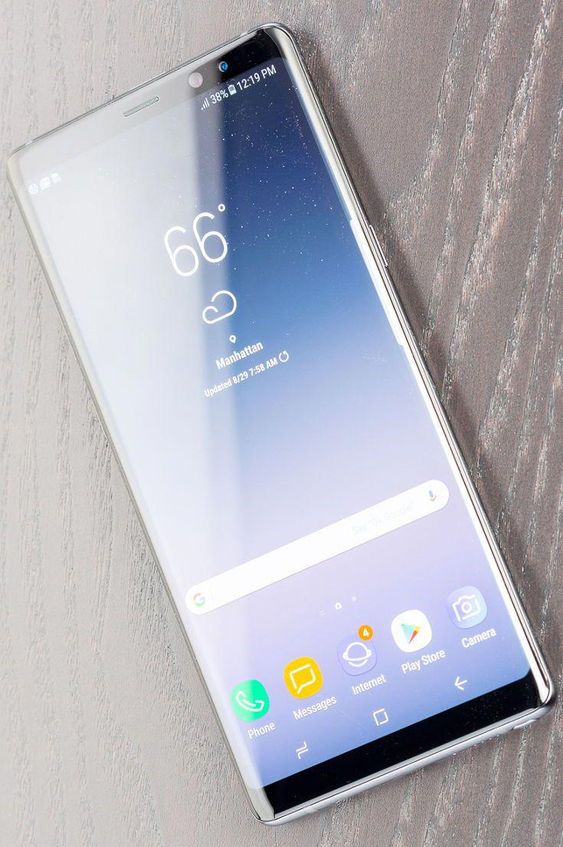
A mobile phone such as this one is a highly useful tool.
Phones for 2019 by PCMag licensed under CC BY 2.0

There are however quite a few problems one would encounter when trying to live without DCT. So much of the world, especially in developed countries such as Australia, has moved from the physical realm to the online. Without using DCT, one would struggle to do regular life activities such as opening a bank account, applying for jobs, and keeping in contact with friends. Being unable to do these things would leave a person socially isolated, and this would likely have a negative effect on their well being, reversing the benefits gained from low mobile phone use in the first place.

In the past, people managed without DCT because, well, it didn’t exist, but they lived in a very different world. Now that DCT is so widespread throughout society it is becoming more and more difficult to live without it. As phone usage is linked to lower well being, perhaps it is unethical for DCT use to be effectively mandatory. Maybe we should also consider options for those who want to go DCT free.


References:

Statistica, 2019. Number of mobile phone users in Australia from 2011 to 2019 (in millions). Retrieved from: https://www.statista.com/statistics/274677/forecast-of-mobile-phone-users-inaustralia/

Volkmer, S., & Lermer, E. (2019). Unhappy and addicted to your phone? – Higher mobile phone use is associated with lower well-being. Computers in Human Behavior, 93, 210-218. http://doi.org/10.1016/j.chb.2018.12.015

ORIGINAL POST:

Could I live without digital communication technologies?

To make a long story short: It’s possible in theory, but I would have to make some serious changes.

As we progress further into the 21st century, the sort of technologies that were unheard of 30 years ago have become ubiquitous. Mobile phones are by far the best example of this phenomenon; there are very few people in developed countries that are still without one. In Australia, there are 20 million mobile phone users (Statistica, 2019) out of a total of only 24 million people. These phones are not just something we enjoy – they are becoming a more and more important part of modern life.
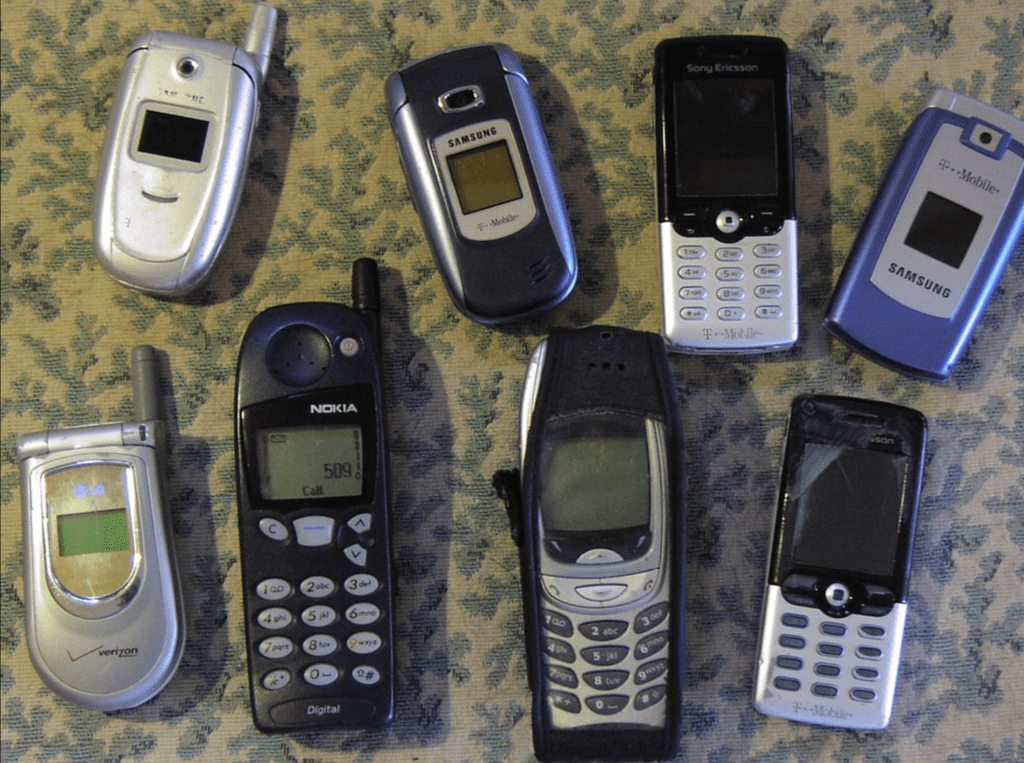
These now obsolete mobiles were cutting edge not 20 years ago.
Image: Phones by Jane Krauss licensed under CC BY 2.0

While the phones in the image I’ve placed above could only make calls and send SMS messages, modern devices have more functionality than even the most kitted-out Swiss army knife. To use my own old iPhone 4S as an example, it can function as a web browser, notepad, phone book, calendar, alarm clock, music player, podcast player, GPS, ebook reader, camera, calculator, even a compass and torch! I could go on well past the word limit for this post listing its functionalities, and the phone I am referring to was released eight years ago now.

Of course mobile phones are not the only digital communication technology (DCT) that we now rely on. Regular old PCs are still as relevant as ever. In my university course, all assignments must be submitted online. This is not unusual, however it would making living my current life without any DCT impossible. I would need to choose a very different future career to be able to live without DCT.

My lifestyle would also need to change significantly. A few personal things that I use DCT for include programming in Python for fun, learning German online, finding sheet music, and of course playing online games.

Living without DCT would be possible, but it would require some big changes that I really don’t want to make.

References

Statistica, 2019. Number of mobile phone users in Australia from 2011 to 2019 (in millions). Retrieved from: https://www.statista.com/statistics/274677/forecast-of-mobile-phone-users-inaustralia/


FEEDBACK FOR ORIGINAL POST:

‘Could I live without digital communication technologies?’ allows us to see how technology, particularly how mobile phones have evolved over time and how their function is so beneficial for many of us. The statistics provided were a great indication to see how many phone users there are in our country and displayed how dependent we can be on them. To further improve this blog post, you could add some more information on how technology affects and impacts an individual’s life, whether it’s positive or negative. Information about the ethical issues that come with technology could be useful for this blog post. Overall, this post was well constructedWell done Hamish!

How modern technology has changed the way we communicate with one another

(Topic 3:An understanding of how changes in technology impact on the way humans communicate, and the ethical issues that surround these changes)

The average American young adult receives over 100 messages over digital communication technologies (DCT) each day (Thompson, P., 2017). This marks a huge departure from the old methods of communication, and as the way we communicate with each other has changed so rapidly, it’s worth asking exactly how these enormous changes have affected our lives.

There are many new ways to communicate with modern technology
Social Media Icons by PNGtree licensed under CC BY 2.0

DCT has introduced a great number of new modes of communication. In the past if we wanted to communicate with someone without physically visiting them we could mail a letter, wire a message, or (by 1900 or so) make a telephone call. DCT has either improved upon or rendered utterly obsolete all three of these. Letters and telegraphs are replaced by e-mail, text messages, and social media, and calls can now be taken from mobile devices between any two points on the Earth. On top of this, these technologies work almost instantaneously.

Because of these changes, we don’t have to plan out communication ahead of time, as messages are now instant and can go anywhere. However, to utilise the speed of these technologies, we are now expected to be available to respond for far longer than we were once required, especially in the workplace. This is negatively affecting people’s work-life balance (Diaz, I., Chiaburu, D., Zimmerman, R., & Boswell, W., 2012). The obvious ethical question here is: Should we be expected to be available to communicate for work outside of work hours? It could increase productivity, but Diaz, I. et al (2012) found that the work-life conflict that this often causes could be unhealthy.

Regardless of which choice we end up taking, DCT is already forcing us to tackle ethical questions, and it will continue to do so in future.

References:

Buser, T., & Peter, N. (2012). Multitasking. Experimental Economics, 15(4), 641-655. https://doi.org/10.1007/s10683-012-9318-8

Diaz, I., Chiaburu, D., Zimmerman, R., & Boswell, W. (2012). Communication technology: Pros and cons of constant connection to work. Journal of Vocational Behavior,80(2), 500-508. https://doi.org/10.1016/j.jvb.2011.08.007

Thompson, P. (2017). Communication technology use and study skills. Active Learning in Higher Education18(3), 257–270.  https://doi.org/10.1177/1469787417715204

No more death by PowerPoint! Why is it important to leave PowerPoint behind?

Microsoft PowerPoint Logo from the Teaching and Learning Hub licensed under CC BY 2.0

PowerPoint has been the staple of slideshow presentations for many years now, but it has its problems. We’ve all sat (or slept) through many PowerPoint presentations where the presenter has read every single word of their seemingly hours-long slideshow at a snail’s pace, in a dull monotone so perfectly steady that you could tune an orchestra to it. Bonus points if this presenter read as if they’d never seen the content before, let alone written it, or if their entire script was on the slides, meaning that the listener must sit through the presenter droning through the same piece of text that they have by now read 4 or 5 times. It’s never a good experience when this happens.

Despite many of us unfortunately experiencing this sort of “Death by PowerPoint”, it has been found that there is no difference in academic achievement between classes that are taught with PowerPoint and traditional “chalk and talk” classes (Baker, Goodboy, Bowman, & Wright, 2018). This could suggest to us educators-to-be that PowerPoint is not the problem – we just need to get better at using it.

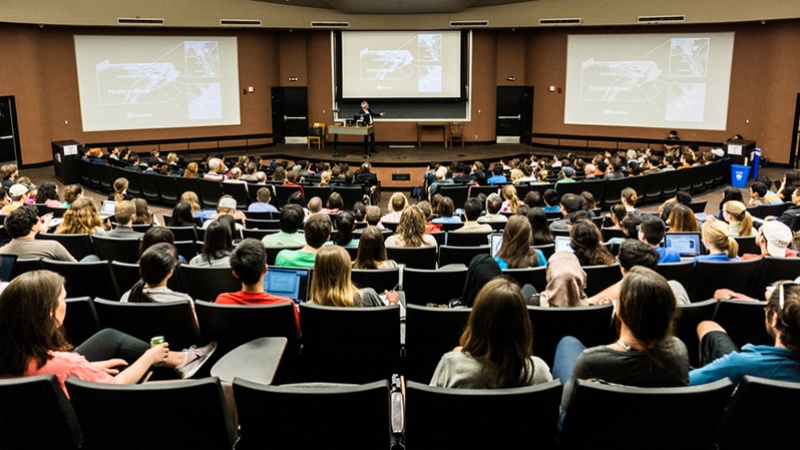
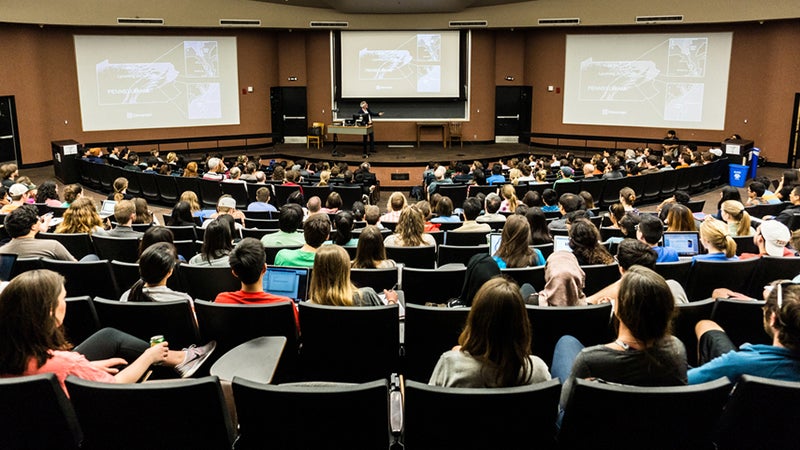
Lecture Hall by University of Oregon licensed under CC BY 2.0

So how can we better engage students with our presentations? We could switch to different software, but as shown by Baker et al (2018), this alone is likely to have no affect on learning or engagement. Instead, we have to make our presentations more interesting in much the same way as we would with a normal lesson. We must not write all of the content on the slides, we must interact with our class/audience, and, above all, must speak like a normal person, with varying pitch and tempo. All of this makes a lesson/presentation feel more natural and engaging. The issue is cannot be simply solved by “leaving PowerPoint behind”.

References:

Baker, Goodboy, Bowman, & Wright. (2018). Does teaching with PowerPoint increase students’ learning? A meta-analysis. Computers & Education,126, 376-387. Retrieved from: https://reader.elsevier.com/reader/sd/pii/S0360131518302070?token=8A582DD697B69B2B7351E0E2188040D29C244DAFCCC62A4B1A036FAEDE5116DC329D0F3D510394411633C9D4C5EA627D

Could I live without digital communication technologies?

To make a long story short: It’s possible in theory, but I would have to make some serious changes.

As we progress further into the 21st century, the sort of technologies that were unheard of 30 years ago have become ubiquitous. Mobile phones are by far the best example of this phenomenon; there are very few people in developed countries that are still without one. In Australia, there are 20 million mobile phone users (Statistica, 2019) out of a total of only 24 million people. These phones are not just something we enjoy – they are becoming a more and more important part of modern life.

These now obsolete mobiles were cutting edge not 20 years ago.
Image: Phones by Jane Krauss licensed under CC BY 2.0

While the phones in the image I’ve placed above could only make calls and send SMS messages, modern devices have more functionality than even the most kitted-out Swiss army knife. To use my own old iPhone 4S as an example, it can function as a web browser, notepad, phone book, calendar, alarm clock, music player, podcast player, GPS, ebook reader, camera, calculator, even a compass and torch! I could go on well past the word limit for this post listing its functionalities, and the phone I am referring to was released eight years ago now.

Of course mobile phones are not the only digital communication technology (DCT) that we now rely on. Regular old PCs are still as relevant as ever. In my university course, all assignments must be submitted online. This is not unusual, however it would making living my current life without any DCT impossible. I would need to choose a very different future career to be able to live without DCT.

My lifestyle would also need to change significantly. A few personal things that I use DCT for include programming in Python for fun, learning German online, finding sheet music, and of course playing online games.

Living without DCT would be possible, but it would require some big changes that I really don’t want to make.

References

Statistica, 2019. Number of mobile phone users in Australia from 2011 to 2019 (in millions). Retrieved from: https://www.statista.com/statistics/274677/forecast-of-mobile-phone-users-inaustralia/

An Introduction

This blog, Perspectives on Modern ICT, was created to share some of my thoughts on the effects of, strangely enough, modern ICT (Information and Communications Technology) on people and on society. I do hope you’ll enjoy the content that will be posted over the next few weeks.

Technology Wallpapers High Resolution is a public domain image.

Statement of academic honesty (As found on the official ACU cover sheet):

By submitting this assignment for assessment, I acknowledge and agree that:

  1. This assignment is submitted in accordance with the University’s Academic Regulations, Assessment Policy and Academic Integrity and Misconduct Policy. I also understand the serious nature of academic misconduct (such as plagiarism) and the penalties attached to being found guilty of committing such offences.
  2. No part of this assignment has been copied from any other source without acknowledgement of the source.
  3. No part of this assignment has been written by any other person, except to the extent of collaboration and/or group work as defined in the unit outline.
  4. This assignment has not been recycled, using work substantially the same as work I have completed previously and which has been counted towards satisfactory completion of another unit of study or credited towards another qualification, unless the Lecturer in Charge has granted prior written consent to do so.
  5. A copy of the original assignment is retained by me and that I may be required to submit the original assignment to the Lecturer in Charge upon request.
  6. The Lecturer-in-Charge may, for the purpose of assessing this assignment:
    1. Reproduce this assignment;
    1. Authorise the reproduction of this assignment;
    1. Provide a copy of this assignment to another member of the University; and/or
    1. Communicate, or authorise communication of, a copy of this assignment to a plagiarism checking service, such as the “Turnitin” service operated by iParadigms LLC (or such other service utilised by the University at its absolute discretion). I acknowledge that a plagiarism checking service provider may then retain a copy of this assignment on its database for the purpose of future plagiarism checking.

Signed: Hamish Butler, S00269480

Design a site like this with WordPress.com
Get started